Redefining and Realising Inclusive Education
What is inclusion, and how do we achieve it? Is it really enough to put all pupils in the same room? This set of questions may be provocative, but it represents a great starting point to discuss inclusive education and its implementation. We often confuse inclusion with simply placing children who might otherwise be excluded in the same physical space as their classmates, concealing their differences behind this fig leaf, but what does true inclusion look like, and what should we do to work towards this target?
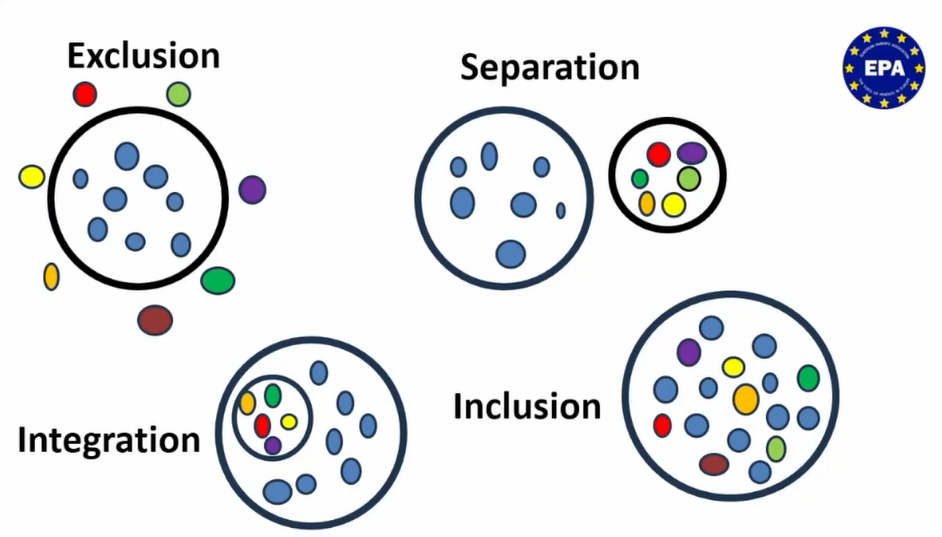
Going beyond the blue dots
Just by turning to the dictionary definition of inclusion, a glaring issue immediately emerges. In fact, this definition focuses excessively on what is lacking, or, in other words, it contains too many “dis-”: disadvantage, disability, etc. This prefix has inherently negative connotations and functions as an example of how much the discourse around the topic is centred around negativity.
Reshaping the way we define these words is not a trivial thought exercise, as language can be considered a lens through which we see the world. An education system can be truly defined as inclusive when all pupils are considered equally, avoiding any type of marginalisation and cherishing the contributions of students from all backgrounds without any discrimination. Exclusion, separation, and even integration are not compatible with true and meaningful inclusion, as they entail a problematic “us and them” mentality that cannot be in harmony with this purpose.
It is also essential to note that these notions are not just directed at children with special educational needs. Quite the opposite, they apply to all children: those who may come from migrant backgrounds, those who may come from a family in a vulnerable situation, or those who may face language barriers, just to name a few.
What should we do?
This cannot be achieved without a plan, as two sets of conditions are required to achieve truly inclusive education. “Outer” conditions cover the more practical aspects of the system, i.e., improving teacher training, obtaining better support systems for pupils with special needs, and building more adequate school buildings. By contrast, “inner” conditions include more cultural (thus less tangible on paper) changes such as emphasising the richness of diversity, getting away from the negative connotation of some terms, and proposing a whole-society approach with contributions from the whole community.
To create these conditions in a real school setting, resources that go beyond the mere, although essential, economic sphere are sorely needed. In fact, time, people, spaces, and support are fundamental components that cannot be lacking, and this is why the role of families should be valued. Meaningful spaces where parents can collaborate and communicate with teachers and the school leadership are essential. Family Support Desks, for example, can help increase families’ engagement with school life. But participation can go even further, through parent networks and advocacy campaigns for inclusive education, transforming parents from recipients into partners in the process of creating an inclusive educational system.
Turning inclusion into reality
In this post, we identified some of the biggest issues around the concept of inclusive education. In fact, the way we talk about inclusion itself should be redefined, and all pupils, with their different backgrounds and educational needs, should be genuinely included and valued. At the same time, we discussed which concrete conditions and resources are needed to obtain true inclusion, and we mentioned how families should be considered as critical cogs in this mechanism.
Ultimately, there is no path forward in the quest to obtain inclusive education other than adopting a whole-society approach that involves all stakeholders. Parents, teachers, school leaders, policymakers, and the wider community all have a role to play, and they should work with the best interests of all pupils as their guiding light.
In case you want to know more about this topic, these ideas were at the heart of the latest “Inclusion Talks” webinar, organised by the European Agency for Special Needs and Inclusive Education (EASNIE), where EPA Project Coordinator Arja Krauchenberg and Elizabeth Gosme from COFACE Families Europe discussed the concept of inclusive education. The webinar is available to watch again on EASNIE’s YouTube channel.
AI usage note: AI was used to check spelling and grammar consistency. All written content is original and was produced by the authors.