Families as Core Partners for Inclusive Education
Creating a fully functioning education system is not an easy task, but creating a fully functioning education system that truly includes all pupils and values their contribution is even harder. To work towards this goal, including families is essential. This was the theme at the heart of the last “Inclusion Talks” webinar, organised by the European Agency for Special Needs and Inclusive Education (EASNIE). EPA Project Coordinator Arja Krauchenberg was one of the two speakers at this event, bringing EPA’s perspective to the discussion, which was followed live by almost 150 participants and can be watched again on EASNIE’s YouTube channel.
Families as part of the solution
Elizabeth Gosme, speaking on behalf of COFACE Families Europe, highlighted the importance of looking beyond disability rights towards a broader vision of inclusive societies in which support systems for families are built so that they can participate fully. She stressed that schools can play an important role as hubs within a wider community ecosystem.
Consequently, this approach also entails the creation of meaningful spaces in which parents and teachers can collaborate and, most importantly, communicate. In particular, she lauded the role played by Family Support Desks, which are connected to schools and help increase families’ engagement with school life.
Parents can and should play an active role even outside pre-existing meeting spaces, though. In fact, Elizabeth listed several forms of “parent activism” that can help this purpose and go beyond participation in school activities. Most importantly, she emphasised the importance of parent networks and especially of joining advocacy campaigns for inclusive education.
Beyond the blue dots: what inclusion really means
Before even addressing the topic of family inclusion, Arja Krauchenberg started her speech by asking what inclusion is. If we turn to the dictionary definition, a glaring issue emerges. In fact, she explained, the dictionary definition focuses excessively on what is lacking, or, to use her words, the definition contains too many “dis-”: disadvantage, disability, etc. This prefix has inherently negative connotations, which makes us reflect on how important language is.
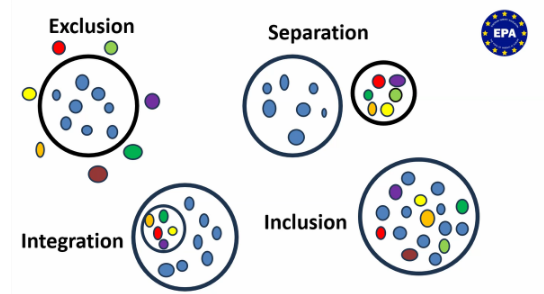
Building on this, Arja explained what inclusion should really mean and, by extension, what inclusive education should really look like. To be truly inclusive, education should consider all pupils equally, avoiding any type of marginalisation and cherishing the contributions of students from all backgrounds without any discrimination. This not only means children with special educational needs, but it also includes pupils who face language barriers or who are from migrant backgrounds. Exclusion, separation, and even integration are not compatible with true and meaningful inclusion, as shown in the graphic above.
The path to successful implementation
The aim should be to achieve what Arja referred to as “liberation”, but two different sets of conditions (defined as “outer” and “inner” conditions) are needed. Outer conditions cover the more practical aspects of the system, i.e., improving teacher training, obtaining better support systems for pupils with special needs, and building more adequate school buildings. By contrast, inner conditions include more cultural (thus less tangible on paper) changes such as emphasising the richness of diversity, getting away from the negative connotation of some terms, and proposing a whole-society approach with contributions from the whole community.
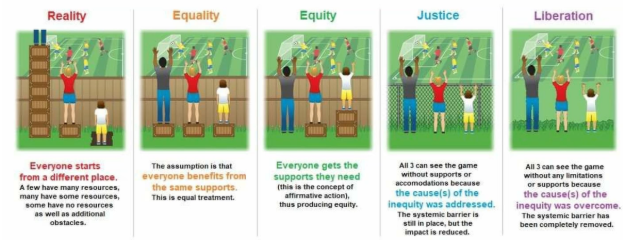
Admittedly, the legal framework is already strong in principle, given that European and international law recognise education as a right and contain important commitments towards inclusion and participation. Nevertheless, implementation often lags behind. This is why, according to Arja, a clear roadmap is needed. Implementation can be done in small and manageable steps, but everyone involved needs to be part of the process and have the resources they need to fulfil their role. In this context, resources are not just economic, but also time, people, spaces, and support. For this reason, an essential step is represented by building local learning ecosystems so the whole community is on board, as learning does not only take place in schools.
Some common themes
During the Q&A portion of the webinar, some questions were raised about some of parents’ most common fears. On the one hand, some parents are worried that inclusive education may slow down the learning process for other children, while, on the other hand, the families of kids with special educational needs are concerned about their children being bullied or excluded. In response, both speakers stressed the importance of communication and cooperation among all actors involved. With the assistance of school leadership, which has an important role to play in creating channels through which such concerns can be openly discussed, parents need to be treated as equal partners.
On the same note, other participants raised concerns that teachers may feel overwhelmed by what they perceive as parental intrusion. Both Elizabeth and Arja agreed that this issue is deeply connected to the previous questions and the themes that were discussed during the seminar, as the answer lies in giving educators both enough support to fulfil their roles and the proper channels to have a constructive dialogue with parents. When the necessary support is absent, it becomes more difficult for teachers to give enough attention to every learner, let alone to effectively take parents’ perspective into account.
The key takeaway from this webinar, as repeatedly stressed by both speakers, is that to reach the goal of truly inclusive education, the involvement of the whole community is required. Even though the legal groundwork, although imperfect, is already in place, proper implementation needs to be supported by parents, teachers, school leaders, and policymakers alike, thus creating a community that can truly foster an environment in which all pupils, regardless of their circumstances, can thrive.
AI usage note: AI was used to check spelling and grammar consistency. All written content is original and was produced by the authors.